Kitchen design in Polish apartments operates under a distinct set of constraints compared to larger residential markets. The typical kitchen in a block-era apartment (blok) or a post-2000 development ranges between 7 and 14 square metres. Working within these dimensions while accommodating standard appliance footprints, adequate storage, and a functional workflow requires deliberate planning before any cabinet order is placed.

Layout Principles in Compact Kitchens
The work triangle concept — positioning the refrigerator, sink, and cooking surface so that the total distance between them falls between 4 and 8 metres — remains a useful starting point for kitchen layout assessment. In compact spaces, the triangle often degenerates into a linear or L-shaped configuration. Both are functional when the sequence sink–preparation surface–hob is maintained.
Common layout configurations in Polish apartment kitchens:
- Single-wall (Galley) kitchen — all elements along one wall; requires at least 180 cm of run to fit refrigerator, base cabinets, and hob in a usable configuration. Common in narrow kitchens between 160 and 200 cm wide.
- L-shaped kitchen — elements along two adjacent walls; provides a continuous worktop corner area and separates the cooking zone from the preparation zone. Works well in rooms from 8 m² upward when the two walls are roughly equal in length.
- U-shaped kitchen — elements along three walls; maximises storage and worktop area but requires a minimum clear width of 120 cm between opposing base cabinets for comfortable movement. In apartments with a kitchen area of 12+ m², U-shapes can accommodate a peninsula or open connection to a dining area.
Cabinet Construction and Materials
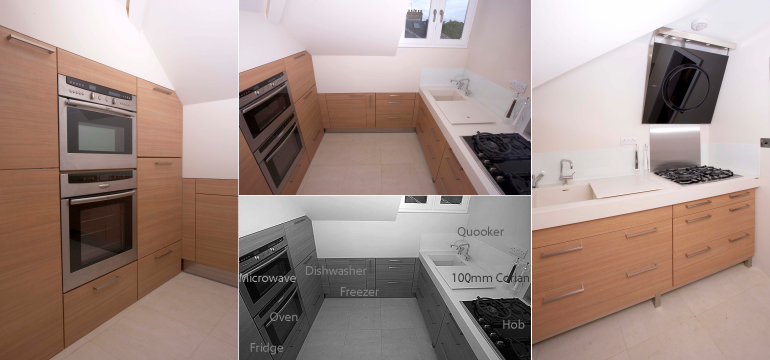
Polish apartment kitchen cabinets are typically manufactured from melamine-faced chipboard (MDF or particleboard) with various edge-banding methods. The primary structural factors to evaluate when selecting kitchen furniture:
Cabinet Carcass
The cabinet box (carcass) is usually 16 or 18 mm particleboard. Thicker boards (18 mm) provide greater rigidity in wider base cabinets and better screw-holding capacity for drawer runners and shelf pins. In humid kitchen environments, boards with a moisture-resistant core (zielona płyta — recognisable by the green colour of the board interior) reduce swelling risk near the sink area.
Doors and Fronts
Door material determines a large portion of the kitchen's visual character and surface durability. The main options available in the Polish market:
- Melamine foil (folia melaminowa) — the most common, lowest cost option; available in a wide range of décors including wood grain patterns; not suitable for high-heat areas directly adjacent to the hob
- Lacquered MDF (lakierowane MDF) — smooth, hard-wearing surface; available in matte and gloss finishes; fingerprints are more visible on gloss; can be damaged by sharp impacts
- Acrylic panels — high-gloss finish with good depth; susceptible to fine scratches from abrasive cleaning materials
- Wood veneer — natural appearance; requires regular treatment with appropriate wood care products to prevent drying and cracking in centrally heated interiors
Drawer Systems and Runners
Drawer runner quality has a significant effect on long-term usability. Full-extension runners allow complete access to drawer contents without the drawer partially obstructing the opening. Soft-close mechanisms are standard in mid-range and higher kitchen furniture; they reduce impact noise and extend the lifespan of drawer fronts and hardware. Undermount runners (concealed below the drawer box) allow lower drawer sides, increasing interior depth.
Countertop Materials
Countertop selection involves balancing durability, maintenance requirements, and visual character. The main materials in Polish kitchen renovations:
- Laminate worktops (blaty laminowane) — most common in the mid-market; available in lengths up to 4.1 metres, typically 38 or 40 mm thick; cannot be sanded after surface damage; post-formed edges (rounded front edge) are the standard finish
- Quartz composite (konglomerat kwarcowy) — engineered from natural quartz aggregate in resin; non-porous, resistant to staining, consistent colour; heavier than laminate and more expensive; seams visible in longer runs
- Granite — natural stone; each slab is unique; requires sealing annually to maintain stain resistance; marks from hot pots less of a concern than with composite; visible crystalline texture varies by source material
- Compact laminate (laminat kompaktowy) — solid-core high-pressure laminate up to 20 mm thick; no chipboard core, therefore more moisture resistant at cut edges; used for countertops and flush-mount upstands
Ventilation and Extraction
Polish building code requires kitchens to have mechanical or natural ventilation. In practice, most older apartment blocks have gravity ventilation shafts (kanały wentylacyjne) that must not be blocked or modified. Range hoods in Polish apartments typically operate in two modes:
- Exhaust (wyciągowy) — ducted to the building's ventilation shaft or to an external wall; more effective at removing moisture and odours; requires a connection to the shaft
- Recirculation (obiegowy) — filters air through activated carbon and returns it to the room; no duct connection needed; requires regular filter replacement (typically every 3–6 months under normal cooking conditions)
Most Polish apartments with pre-existing ventilation shafts can support exhaust mode for a range hood, provided the connection is made properly and does not permanently seal the shaft (a connection with a valve that closes when the hood is off is required in many cases to prevent shaft pressure equalization issues).
Splashback Materials
The wall area behind the hob and countertop — the splashback — requires a material resistant to moisture, grease, and heat. Ceramic tile remains standard in Polish kitchens, but glass and stainless steel panels have become common alternatives:
- Ceramic / porcelain tile — durable, wide range of finishes, grout lines require maintenance to prevent discolouration
- Tempered glass panel — single-piece installation eliminates grout; can be back-painted or decorated; minimum distance from hob required per manufacturer specification (typically 70–90 cm unless rated for hob proximity)
- Stainless steel — used in domestic kitchens as a professional-look surface; susceptible to visible fingerprints and light scratches; brushed finish hides marks better than polished